
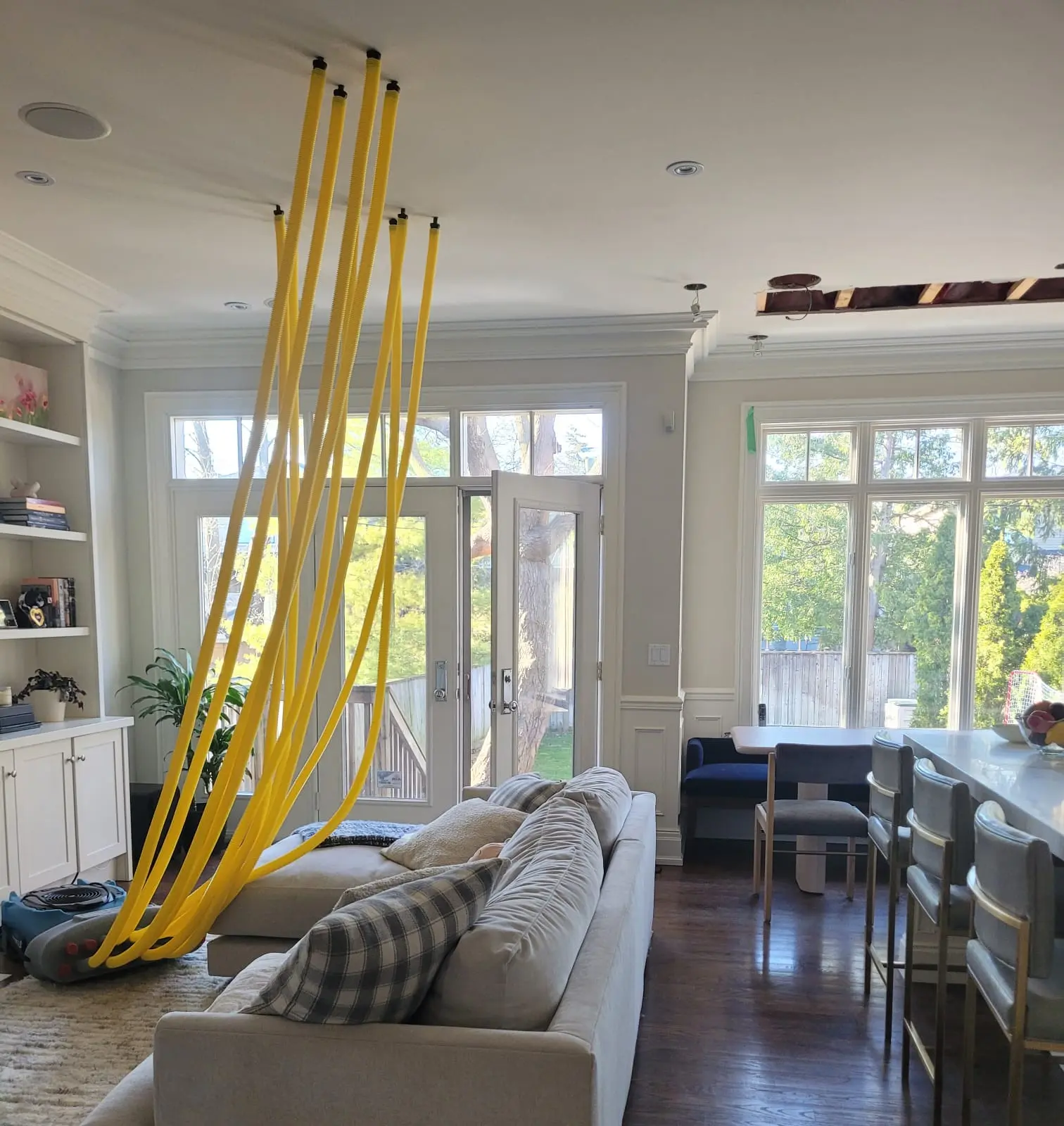
You locked the house, loaded the car, and drove north for two weeks. Your basement looked fine when you left. Then a pipe quietly started leaking, a sump pump failed, or a foundation crack let in July's humidity. For fourteen days, your basement filled with water. Nobody was there to notice.
We get these calls every summer. Homeowners come home from vacation in Muskoka or a week at the cottage, open the basement door, and find standing water. Sometimes it's already too late. The damage compounds every single day you're gone, and what might have been a four-figure restoration bill on day one becomes a five-figure disaster by day eight.
What happens in the first 24 hours
The moment water enters your basement, the clock starts. Within the first day, if you're not there to stop it:
- Drywall starts absorbing water. Inside your walls, the paper and gypsum are soaking it up. On the surface, everything still looks dry. But behind the surface, you're building the perfect environment for mould.
- Carpet and padding soak through. If you have finished basement rooms, the carpet is now sitting on wet pad. The smell comes later, but the damage starts immediately.
- Concrete and foundation absorb moisture. Even concrete that looks dry has moisture trapped inside the pores, wicking deeper into the foundation.
The 48-hour threshold
This is the critical window in Toronto water damage restoration. At 48 hours, mould spores start germinating inside your walls. You still might not smell anything. The basement air still feels normal. But biologically, something has shifted. By the time you get home from your two-week vacation, you're well past this point.
We use thermal imaging cameras on most vacation-related water damage calls because the visible water is often gone by the time the homeowner returns. The carpet dried from the surface. The floor looks okay. But the thermal image shows exactly how deep the moisture went, and where mould is already colonizing inside the walls.
Week two: what you come home to
By the time you return home after a two-week vacation, several things have happened in your basement:
- Mould is visible. You'll see dark spots on walls, or a thin white film on insulation. The basement smells distinctly musty, not just damp.
- Wood framing has started to soft. Joists, rim board, studs in the walls. Not failing yet, but wood fibre has begun breaking down. Structural assessment will be needed to see how deep the damage goes.
- Subfloor is likely compromised. If your basement is finished, the OSB or plywood subfloor underneath has been wet for two weeks. It has lost structural integrity and likely needs replacement.
- Drywall is saturated. Most drywall that sits wet for longer than 48 hours cannot be saved. It needs removal and replacement.
- Insulation is a loss. Fiberglass or mineral wool insulation that's been wet for two weeks is compromised and needs removal.
The cost difference is brutal
A basement flood caught on day one in Toronto typically costs $2,000 to $5,000 for extraction, drying, and a cleanup. Structural elements stay intact. Drywall and insulation get dried out. Some things can be salvaged.
The same basement flood caught on day fourteen costs $8,000 to $15,000 or more. Mould remediation is required. Walls, insulation, and subfloor are demo and replace, not dry and restore. Structural inspection is needed. The labour and material costs triple because you're not treating water damage anymore, you're treating water damage plus mould contamination.
We've seen vacation-discovered basement floods reach $25,000 when structural damage required repair or when mould remediation spanned the entire basement.
What to check before you leave for vacation
If you're heading away for more than a few days in July or August, spend ten minutes on these checks:
- Check your sump pump. Run the float switch manually. Pour water into the basin. Does it kick on? Does it discharge water outside? If you have a battery backup sump pump, test that too.
- Look at the gutters and downspouts. Clear leaves and debris. Make sure downspouts discharge at least six feet away from the foundation. Water dumped against the foundation in July heat will eventually find its way to the basement.
- Check window wells. Clear any standing water or debris. Make sure drain pipes are clear. Window wells are a major entry point for water during summer thunderstorms.
- Look at the foundation wall visually. Scan for any visible cracks, gaps, or spots where water has been seeping. Make a note of those spots before you leave.
- If you have a basement window or door, test the seals. Run a hose on it or watch it during the next rain. Does water come in around the frame?
What to do if you come home to water damage
You walk in. Your basement is wet. Here's what to do:
- Kill the power to the basement immediately. Flip the breaker. Wet basements are electrical hazards. If the panel is in the basement and flooded, call your utility company.
- Document everything. Video and photos of waterlines on walls, all contents, flooring condition. This is your insurance claim. Take shots of the furnace, water heater, any equipment that's been affected.
- Call a restoration company that day. Not tomorrow. That day. The longer the water sits, the more expensive the job. A call on day fourteen costs far more than it would have on day one.
- Call your insurance company. Report the claim. Most insurance adjusters will ask for restoration company recommendations or direct you to file a proof of loss. The sooner you start, the sooner the assessment happens.
- Do not try to dry it yourself. Box fans and portable dehumidifiers will not dry out walls and subfloor. Professional water damage restoration equipment operates at a completely different scale. What looks fine on the surface still has moisture trapped inside, and DIY drying often locks that moisture in while just surface-drying things.
Prevention for next vacation season
If you're going away regularly, especially during summer when thunderstorms and heat are common, consider:
- Battery backup sump pump. If yours runs on power alone and the power fails during a storm, you're flooding. A battery backup costs $400 to $800 and is worth every dollar.
- Water alarm or moisture detector. Inexpensive battery-powered devices (under $50) will alert you if water reaches the basement floor. Mount one where water is most likely to intrude.
- Ask a neighbour to check in. Even a text check: "Hey, can you peek into our basement window well and let us know if there's water?" can catch a problem early.
- Install a backwater valve. If your basement floods from sewer backup, a backwater valve prevents raw sewage from backing up into your home. Toronto subsidizes these up to $3,400, so the cost is often minimal.
Don't let summer vacation turn into a nightmare
Two weeks of undetected water damage is vastly more expensive than water damage caught in the first day. If you come home to a wet basement, or if you want help identifying risk factors before you leave, call us. We can inspect your basement, test your sump pump, and help you prevent this headache from happening at all.
GTA homeowners trust us with emergency flood restoration, and mould remediation and inspection in homes across Toronto, Mississauga, Vaughan, Markham, Scarborough, and beyond. If water damage happens while you're away, we're here.
Call us at 647-563-9966 anytime, day or night. We pick up every call, every time.
The Preferred Group
IICRC Certified restoration team. Toronto-based, working across the GTA since 2006. 6,000+ projects under our belt.