
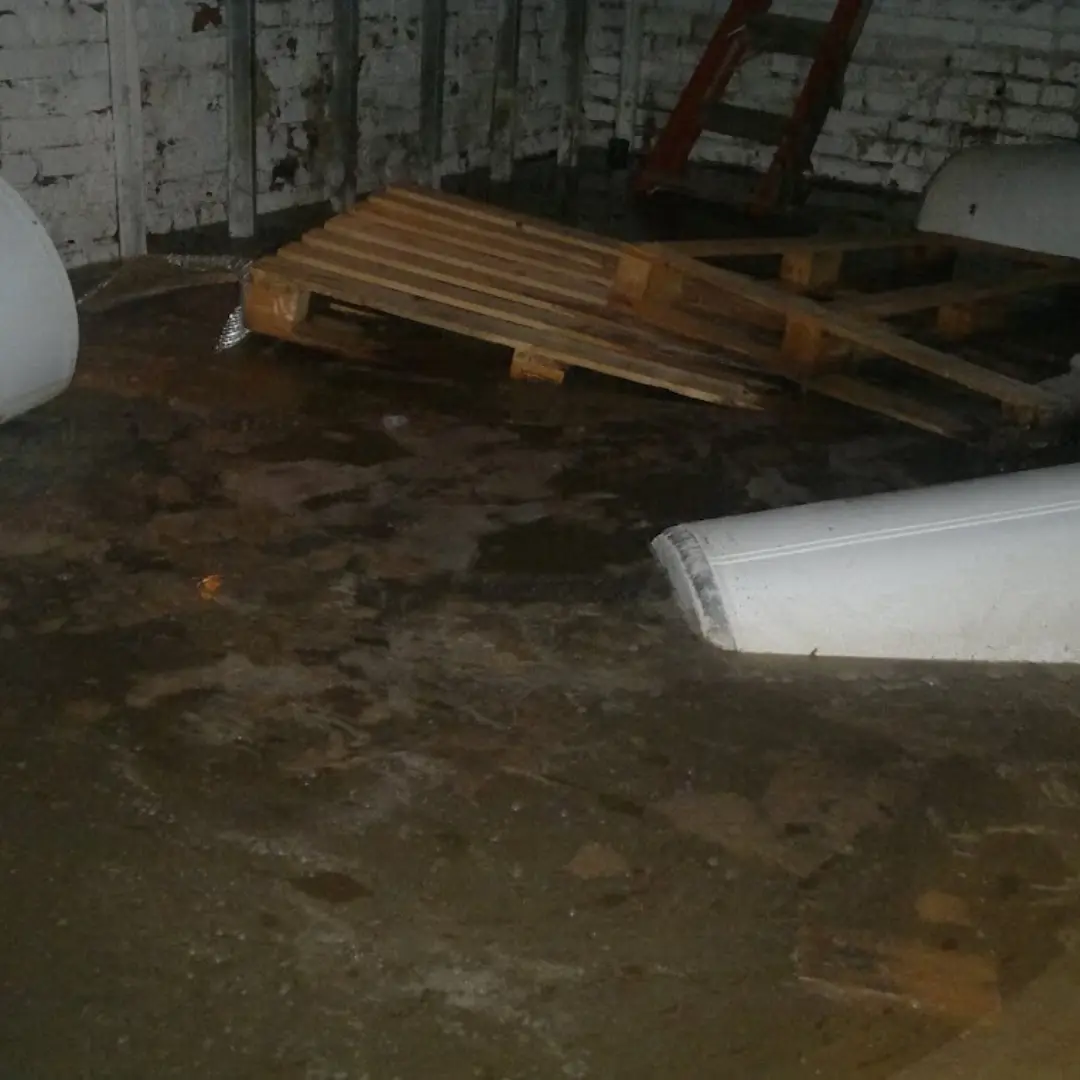
We get this call at least twice a week. A homeowner had a basement flood, rented a couple of dehumidifiers from the hardware store, set up a box fan pointed at the wet floor, and thought they'd handle it themselves. A week or two later they notice a musty smell and call us in a panic. By then the mould is already growing inside the walls.
The dehumidifier worked exactly as designed. It's doing what it was built for: removing moisture from the air in an open space. It's just not designed for water damage restoration. And that's the problem.
What a residential dehumidifier actually does
A standard household dehumidifier pulls humid air across a cold evaporator coil, collects the water that condenses, and pushes dry air back into the room. It works great for an extra-humid basement or a finished basement that gets steamy in summer. In those situations, you're fighting airborne moisture, not wet materials.
After a flood, the problem is completely different. Your drywall has absorbed water. Your subfloor has absorbed water. The fiberglass batt insulation in your rim joist has absorbed water. None of that moisture is "in the air." It's trapped inside the materials themselves, and it's slowly migrating deeper into the wall assembly as capillary action pulls it upward and inward.
A dehumidifier can't reach it. All it can do is dry out the surface moisture that's already evaporating back into the room. Meanwhile, mould is starting to grow inside the wall where you can't see it.
Why mould wins when you wait
Mould needs three things: moisture, oxygen, and a porous surface. After a basement flood in Toronto, you've handed mould all three. Drywall, wood framing, and fiberglass insulation are perfect mould food. They're all porous. They all absorb water. And they all stay wet for days even after the surface looks dry.
In a postwar bungalow in Scarborough or Etobicoke, that fiberglass batt sitting against the foundation wall can stay damp for two to three weeks without active drying. Mould starts growing in the first 24 to 48 hours. By day five, it's spreading deep into the cavity. By day ten, you've got a serious contamination that requires mould remediation instead of just drying.
A dehumidifier running 24 hours a day won't change that timeline. It's not getting moisture out of the materials themselves. It's just handling the water that's already evaporated into the air, which is only a tiny fraction of the total moisture load.
What industrial drying equipment actually does
Professional water damage restoration equipment is built on a completely different principle. Instead of relying on passive evaporation into humid air, it forces rapid evaporation by moving large volumes of air across wet surfaces and carrying that moisture away fast.
Here's what a proper drying setup looks like:
- Centrifugal air movers. These aren't box fans. They're heavy-duty machines that push 4,000 to 7,000 cubic feet of air per minute. Compare that to a residential fan at maybe 1,000 CFM. That volume of air creates rapid evaporation from wet materials.
- Refrigerant dehumidifiers. Not the household kind. Industrial units that can handle very high moisture loads and keep operating efficiently even in very humid conditions. They're sized for the job, not for a bedroom.
- Heat. Controlled heating increases the capacity of air to hold moisture, which speeds evaporation further. You might see heaters running alongside the equipment to raise the room temperature by 5 to 10 degrees. That seems small, but it cuts drying time in half.
- Targeted air flow. Instead of one fan blowing generally in a direction, drying equipment is positioned to move air directly across wet surfaces, through wall cavities, and under flooring. It's deliberate and measured.
All of that working together creates an environment where moisture leaves materials fast, gets captured, and is removed from the space. It's not elegant. It's loud. Equipment fills your basement. But it works.
Why the timeline matters so much
After a water damage event in Toronto, there's a hard line at 24 to 48 hours. That's when mould starts growing. That's also when the cost equation flips.
If you call a restoration company within a few hours of the flood, here's what happens: We extract standing water, set up drying equipment, and leave it running for two to four days. The space gets completely dry. No secondary damage. No mould. Cost might be $2,000 to $5,000 depending on the size and what got wet.
If you wait a week and try the dehumidifier route, and then call when you notice a smell, here's what we find: Mould growing in the wall cavities. Drywall that needs to come out. Possibly subfloor that's compromised. Structural framing that needs treatment. You're now looking at $4,000 to $10,000 or more.
The math is brutal. The faster you move, the cheaper it is. The longer you wait, the more expensive it becomes.
What to do in the first few hours
If your basement is actively flooded or you've just discovered water intrusion:
- Kill the power to the basement immediately. Water and electricity don't mix. Do this first.
- Call a professional restoration company right away. Don't wait to see if it dries on its own. Don't assume the dehumidifier you have will handle it. Call while the sun is still up if you can, or as soon as you notice.
- Document what happened with photos and video. This is for insurance. Don't wait to do this either.
- Start moving valuables off the floor if it's safe to do so. But don't spend hours trying to dry things yourself. Let the professionals handle it once they arrive.
A professional drying crew can be on-site in an hour in Toronto or the GTA. Industrial equipment can be set up and running within two hours of arrival. That speed is the difference between a $3,000 job and a $10,000 job.
When the dehumidifier by itself actually works
To be fair, there are scenarios where a dehumidifier alone is genuinely enough:
- A very small amount of clean water. If you caught a slow toilet overflow in the first few minutes and mopped it up, and the affected area is just a few square feet, a dehumidifier can help finish drying what's left.
- Surface moisture only. If water got on top of sealed concrete or tile and you've already wiped up the bulk of it, a dehumidifier can handle residual moisture in the air.
- You've already called the pros and equipment is running. Once industrial drying equipment is set up, a dehumidifier can supplement it in adjacent areas.
Anything beyond that, you need professional help. Anything that involves basement walls, flooring, insulation, or any amount of standing water, call immediately.
The bottom line
That dehumidifier in the hardware store is a useful tool for some situations. Water damage restoration is not one of them. The cost of professional drying for two to four days is dramatically less than the cost of mould remediation after you waited.
If you've had water intrusion in your basement in the past week, or if you're noticing any musty smell that appeared after water got in, call us at 647-563-9966. We can be on-site fast, scope the damage, set up the right equipment, and get your home dried before mould takes hold. We work 24 hours a day, seven days a week. Someone answers every time.
The Preferred Group
IICRC Certified restoration team. Toronto-based, working across the GTA since 2006. 6,000+ projects under our belt.