
After a basement flood in Toronto, most homeowners focus on what they can see: the waterline on the drywall, the ruined furniture, the wet carpet. A few days later the floor looks dry. They bring in a fan, clean up the visible mess, and move on.
Six months later they notice a soft spot near the hallway. A bounce in the middle of the living room that wasn't there before. A faint musty smell they can't track down. That's water damage Toronto homeowners miss every summer, and it's the kind that gets expensive.
The floor is rotting from the inside out.
Why the surface looks dry when the damage is underneath
Water doesn't stay on top of hardwood or tile. It moves to the path of least resistance: the seams between boards, the grout lines, the gap at the baseboard. It gets into the subfloor. In most GTA homes built between 1945 and 1975, that subfloor is 3/4-inch tongue-and-groove pine or fir sitting on wood joists, typically 16 inches apart, 12 to 18 inches above the concrete slab.
The surface hardwood can feel dry to the touch within a day or two. The subfloor below it holds moisture much longer, sometimes for weeks. Wood sitting at moisture content above 19% will start to decay. Not quickly, but it will. And mould in a subfloor cavity can get going in under 48 hours.
Residential fans move surface moisture. They do not dry a subfloor assembly. That takes professional drying equipment, the kind used in proper flood restoration work.
Signs of floor rot you can detect yourself
You don't need any equipment to find most of these. Walk the affected area slowly and pay attention:
- Soft or spongy spots when you step down. Press the heel of your shoe firmly into the floor in several spots. A solid floor doesn't give at all. Any flex or give is a red flag.
- Bounce or spring in the middle of a span. Stand in the middle of the room and rock your weight heel to toe. A floor that moves has something wrong underneath.
- Hardwood boards cupping, lifting, or buckling at the edges. Moisture coming from below pushes the edges of boards up while the centre stays flat. This is a classic sign of wet subfloor.
- Visible gaps opening between boards. Boards that were tight before a flood and now show gaps have dried unevenly, which means they got wet unevenly.
- Musty smell at floor level that doesn't clear. Get on your hands and knees near the baseboard and smell. Active mould in a subfloor cavity has a distinct earthy smell that doesn't go away with ventilation.
- Doors that suddenly stick or won't latch. A floor that's swelling from moisture will shift the door frame just enough to cause binding at the top or latch side.
- Discolouration along grout lines or baseboards. Dark staining in grout or at the wall-floor transition is often mould already spreading.
Where it hides in GTA homes specifically
Not all floors are equally at risk. After years of flood restoration work across Toronto, Scarborough, North York, Etobicoke, and Mississauga, these are the situations where we find the worst hidden damage:
Basement rec rooms with carpet over OSB over concrete. Carpet holds moisture for weeks and acts as an incubator. The OSB subfloor underneath gets saturated before anyone notices. By the time the carpet feels dry on top, the OSB may already be breaking down.
Main floor hardwood above a wet basement. Water doesn't need to directly touch your main floor to damage it. In a postwar bungalow with an unfinished basement, prolonged high humidity from a flood below can wick up into the subfloor from underneath. We see this in homes across Etobicoke and North York regularly.
Century homes in the Junction, Leslieville, and East York. A lot of these have double-floor construction: a diagonal subfloor layer, then a finish floor on top. There's a dead air space between the two layers that traps moisture like a sealed bag. By the time you smell anything, the decay is well underway.
Bathroom and laundry room transitions. Where tile meets hardwood is almost always a weak point for water intrusion. The grout and transition strip don't seal well under flood conditions, and the hardwood on the other side soaks up water from the edge.
Why thermal imaging finds what your eyes can't
The only way to know for certain whether a subfloor is actually dry is to measure it. A surface that looks dry can still have moisture content of 30, 40, or 50 percent in the wood two inches below.
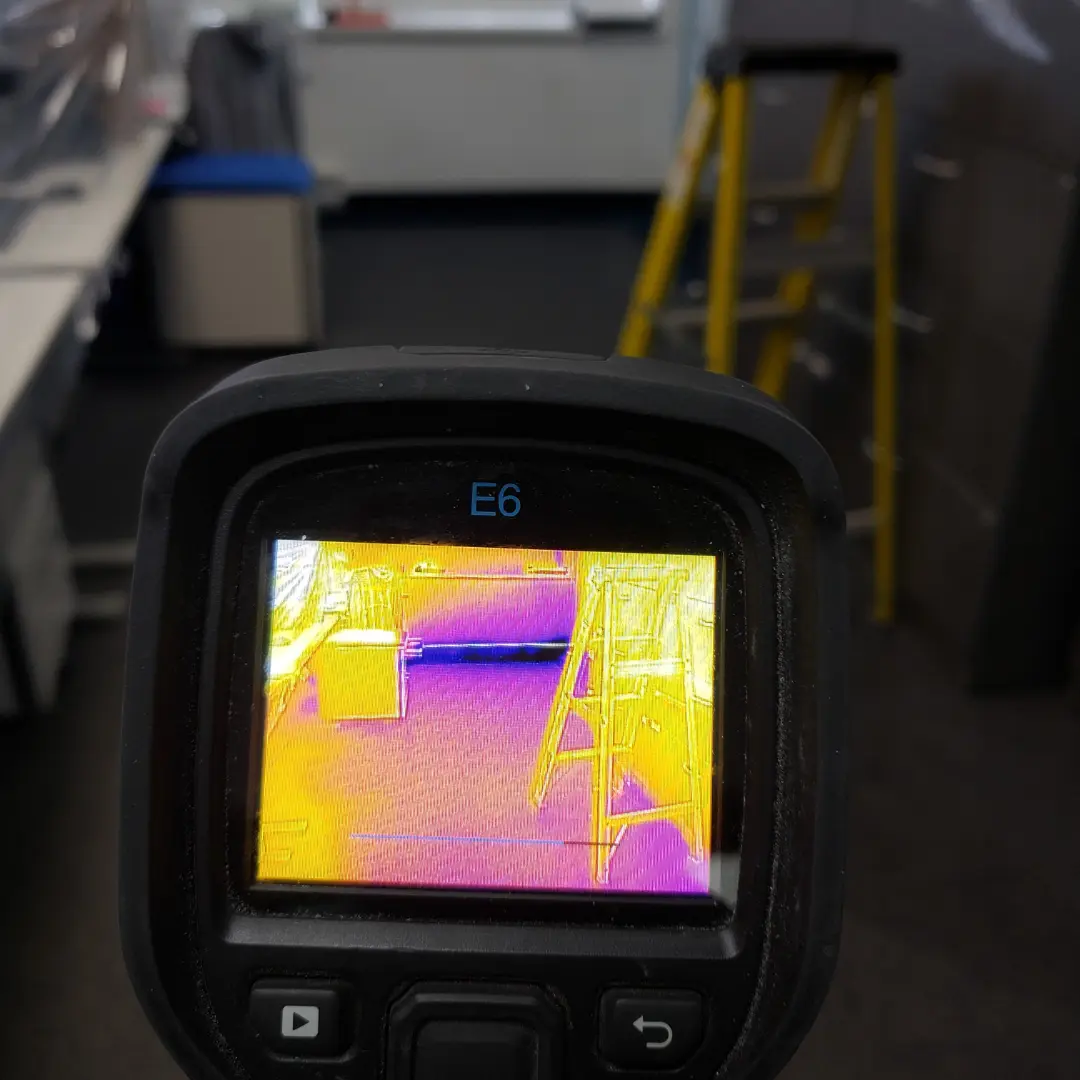
We use thermal imaging on every significant flood job. A FLIR camera maps the temperature differential across a floor surface. Wet areas hold temperature differently than dry ones, so moisture that's invisible to the eye shows up clearly as a distinct pattern. It tells us exactly where the damage is and how far it extends, so we're not guessing what to open up.
Homeowners sometimes ask whether a cheap moisture meter from the hardware store will do the job. It helps at the point you're measuring, but it only gives you one reading at a time. Thermal imaging gives you the full picture of the entire floor in one pass. The two together tell us almost everything we need to know before we start pulling up floor material.
What it costs if you wait versus if you act fast
Here is the math that makes this decision straightforward.
Professional wet floor drying done within the first week of a flood typically runs $1,500 to $4,500 depending on the size of the area and materials involved. Most of that is covered by standard Ontario home insurance for sudden and accidental water damage.
If you wait until the rot reaches the joists, you're not talking about a drying job anymore. You're talking about a structural repair: opening the floor or ceiling, sistering new lumber alongside rotted joists, replacing the subfloor, and reinstalling the finish flooring. That job starts around $15,000 and can go well past $30,000 for a larger basement area. And at that stage, the delay itself may create problems with your insurance claim.
Ontario insurance policies typically require homeowners to take reasonable steps to limit damage after a water event. If an adjuster sees evidence that you waited six weeks before calling anyone, that gap becomes a problem for the claim. IICRC certified restoration companies document moisture levels on arrival, which establishes the timeline your insurer needs.
When to stop inspecting yourself and call a professional
Any of these, call today. Don't wait to see if it gets better on its own:
- You feel a soft spot anywhere in the floor, even a small one
- You smell something musty at floor level that won't go away
- You see hardwood boards cupping or lifting
- The flood happened more than 48 hours ago and the floor was never professionally dried
- You had water in a finished basement with carpet
- You had flooding and your home has a crawl space rather than a full basement (crawl spaces hold humidity and rot joists faster than almost any other configuration)
What the assessment looks like
When we come out for a post-flood moisture check, it takes about an hour for an average-sized home. We walk the affected areas with the thermal camera, follow up with pin-type moisture meters at flagged spots, and give you a clear picture of what's actually happening under the surface.
If the floor is genuinely dry, we tell you that and you've spent an hour of your time. If there's a problem, you've caught it early enough to fix it cleanly.
If you've had any water in your home in the past few weeks and you're not sure about the floor condition, call us at 647-563-9966. We serve Toronto, Scarborough, North York, Etobicoke, Mississauga, Vaughan, Markham, and Richmond Hill. Someone picks up any hour, any day.
The Preferred Group
IICRC Certified restoration team. Toronto-based, working across the GTA since 2006. 6,000+ projects under our belt.