
Hardwood floor water damage is one of the first things Toronto homeowners panic about after a basement flood or burst pipe. You look at boards that have been under water for a few hours and figure the whole floor is garbage. Sometimes that's true. But a lot of the time it isn't, and the difference comes down almost entirely to how fast you act and how the drying gets done.
We've dried hundreds of hardwood floors across the GTA, from old-growth oak in century homes in the Annex and Leslieville to engineered flooring in newer builds in Vaughan and Markham. This is what we actually see on the job.
What water does to hardwood, step by step
Wood is hygroscopic. It absorbs moisture from the air and from direct contact with water. When hardwood gets wet it expands, and because the floor is locked in on all sides by walls and transitions, that expansion has nowhere to go.
What you see depends on how long it was wet and where the moisture moved:
- Cupping: The edges of each board rise higher than the center, giving the floor a wavy, ribbed look. This happens when the bottom of the board picks up more moisture than the top. It's often reversible if you catch it within 24 to 48 hours.
- Crowning: The center of each board rises higher than the edges. This can happen when the top surface got wet and the bottom stayed drier, or when a cupped floor was dried too aggressively. It's harder to recover from than cupping.
- Buckling: Boards lift completely off the subfloor, sometimes rising several inches. This means the wood expanded enough to pull the nails or staples holding it down. At this point the boards themselves are usually not salvageable.
- Checking and splitting: Cracks along the grain. Usually caused by drying too fast, not by the water itself. This is DIY damage, not flood damage.
Hardwood floor water damage: what's actually worth saving
Solid hardwood that was wet for under 24 hours has a good recovery rate when dried with professional equipment. Engineered hardwood (a real wood veneer bonded over plywood or HDF core) can be more forgiving because the layers stabilize each other, but it's also more sensitive to the core material getting saturated.
Here's what actually determines whether your floor can be saved:
- Time in water. Under 12 hours with clean water gives you the best shot. Past 48 hours things get harder. Past 72 hours, the subfloor is usually compromised even if the hardwood surface looks okay.
- Type of water. Clean pipe water is best case. Storm water coming in through window wells or a foundation crack is category 2 (contaminated with soil bacteria and debris). Sewer backup is category 3, a biohazard, and any hardwood that sat in it comes up, full stop, regardless of how it looks on the surface.
- Subfloor condition. Most postwar bungalows and semis across Scarborough, Etobicoke, and North York have plywood or OSB subfloors. These absorb moisture fast and take weeks to dry fully. If the subfloor has started to delaminate or feels soft underfoot, you're pulling the hardwood anyway to replace it.
- Glued vs. nailed. Glued-down hardwood over concrete (common in Mississauga condos and Oakville townhomes) traps moisture underneath with no escape route. Nailed-over-subfloor assemblies have much better airflow options for in-place drying.
How professional wet floor drying actually works
Water damage restoration companies don't just point fans at the floor and wait. The goal is to move moisture out of the wood slowly and evenly. Moving it too fast causes the surface cracking and splitting that looks worse than the original flood damage.
The main tools in a proper drying setup:
- Desiccant dehumidifiers: These pull moisture from the air at the molecular level, holding the relative humidity in the room very low so the wood has somewhere to release moisture into. The hardware store condensate dehumidifier in your basement does not come close to what a commercial desiccant unit does, especially in a cool spring basement where condensate units underperform badly.
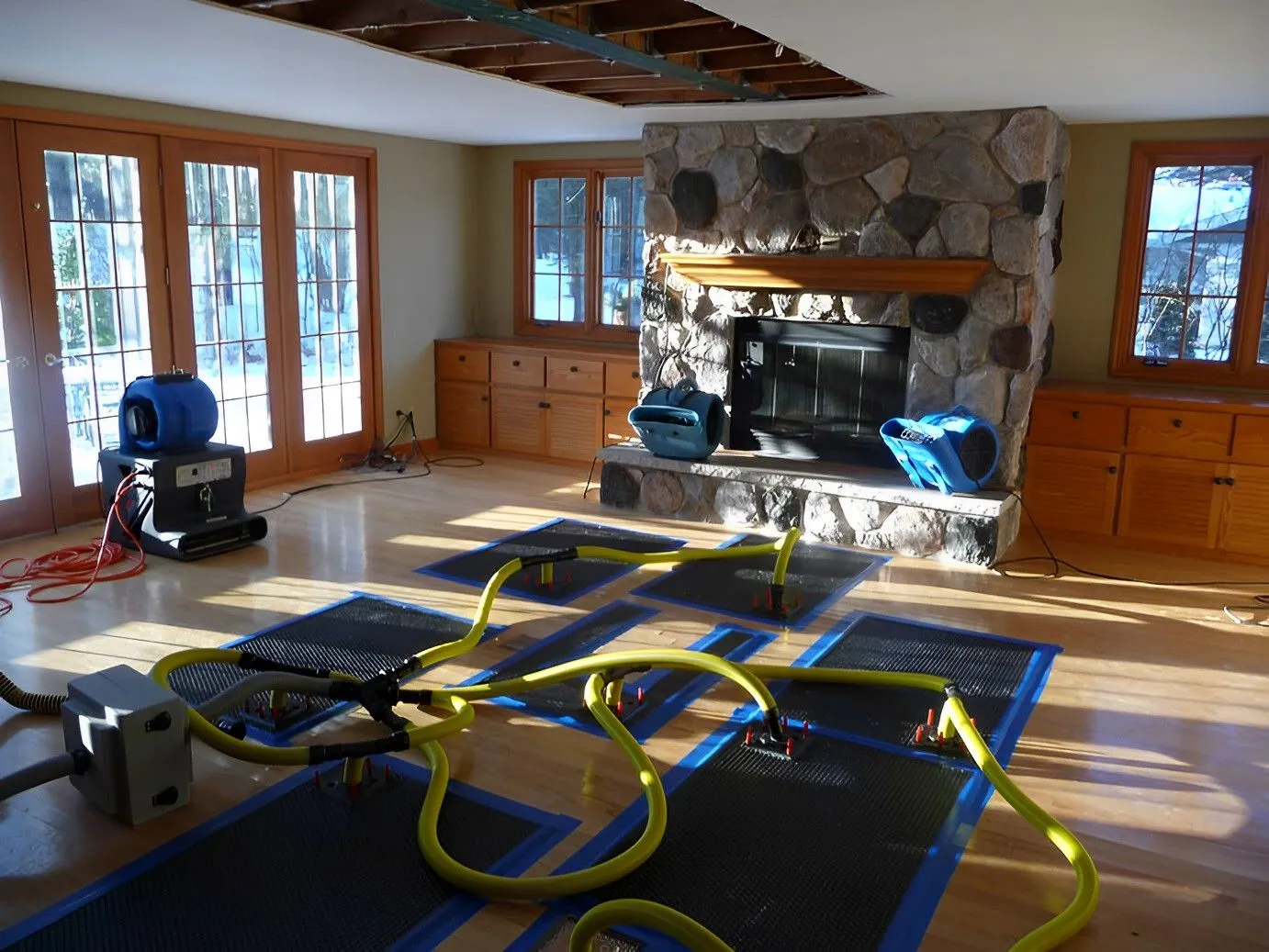
- Low-profile air movers: These direct high-velocity air across the floor surface rather than over it. The goal is to keep the evaporation front moving from the wood into the air where the dehumidifier can capture it.
- Drying mat systems: For glued-down hardwood over concrete, we attach drying mats directly to the floor surface. These draw moisture up through the wood using negative pressure. It's the only way to dry glued-down floors in place without tearing them up.
- Thermal imaging: A FLIR camera shows exactly where moisture is hiding. What looks and feels dry on the surface can still be saturated 10 mm down. You can't dry what you can't find.
- Daily moisture meter readings: Taken at fixed locations to track whether the drying curve is on target. IICRC drying standards specify moisture content thresholds for wood, not just "looks dry."
A standard hardwood drying job runs 3 to 7 days with professional equipment in place. Rushing it causes more damage than the water did.
What goes wrong with DIY drying
The instinct after a flood is to open windows, crank the furnace, and point every fan in the house at the floor. In May in Toronto, outdoor air is already carrying significant humidity. Blowing humid air across wet boards does not dry them. Moisture moves from high concentration to low, and if you're pumping in air that's already at 60 or 70% relative humidity, you're moving almost nothing.
The bigger problem is uneven drying. Heating the air without controlling humidity dries the top surface of the boards while the bottom stays saturated. That's exactly the moisture gradient that causes crowning and checking. We've had calls from Richmond Hill and Oakville homeowners who ran fans for 48 hours and then phoned us when their floor started cracking. At that point, some boards can still be sanded and refinished, but it's not guaranteed.
Also: a regular household dehumidifier running in a flooded basement in May is unlikely to keep up with the moisture load coming out of wet wood, wet framing, and wet concrete simultaneously. It will run constantly and make almost no measurable drying progress.
When the floor can't be saved
Buckling is the clearest sign. If boards are lifting off the subfloor, the fasteners have already failed under expansion pressure, and there's no mechanical way to pull them flat during drying. Those boards are done.
If the subfloor is soft underfoot, or you can see that OSB layers have started to delaminate and swell, you're looking at a subfloor replacement regardless. At that point the hardwood question is secondary.
Replacement cost for hardwood in the GTA runs roughly $8 to $18 per square foot installed, depending on species, grade, and whether you're going back with solid or engineered. A 400 square foot basement floor is a $3,200 to $7,200 replacement project. Professional drying typically costs a fraction of that. It's always worth a call before you start pulling boards up.
Hardwood floor water damage and your insurance claim
Most standard Ontario home insurance policies cover sudden and accidental water damage, including hardwood floors ruined by a burst pipe. Sewer backup is usually a separate add-on, but if you have it, floors are covered under it.
The adjuster will want to know whether professional drying was attempted before demolition. This matters. If you pull the floor yourself without documentation and then make a claim, you'll face questions about whether the damage was as described. Calling a certified water damage restoration company first creates a documented drying log that supports your claim. We work directly with most major Ontario insurers and can bill them directly, which takes a significant piece off your plate.
The mould problem no one talks about
Hardwood that stays wet for more than 24 to 48 hours in warm conditions will start growing mould on the underside and in the subfloor below. You cannot see it from above. By the time you smell it, it's already in the structure.
In May, basements across the GTA are sitting at elevated ambient humidity from spring rain and snowmelt. That speeds up mould growth considerably. A floor that might have had a 48-hour safe window in January could be showing active mould at 24 hours in May.
Mould remediation on top of water damage restoration is a significantly larger and more disruptive project. Moving fast on the drying is the best mould prevention there is.
If your floors got wet and you're not sure whether drying makes sense, call us at 647-563-9966. We can be on site same day across most of the GTA, take proper moisture readings, and give you a straight answer on whether the floor is saveable or whether replacement is the better call. No pressure either way.
The Preferred Group
IICRC Certified restoration team. Toronto-based, working across the GTA since 2006. 6,000+ projects under our belt.