
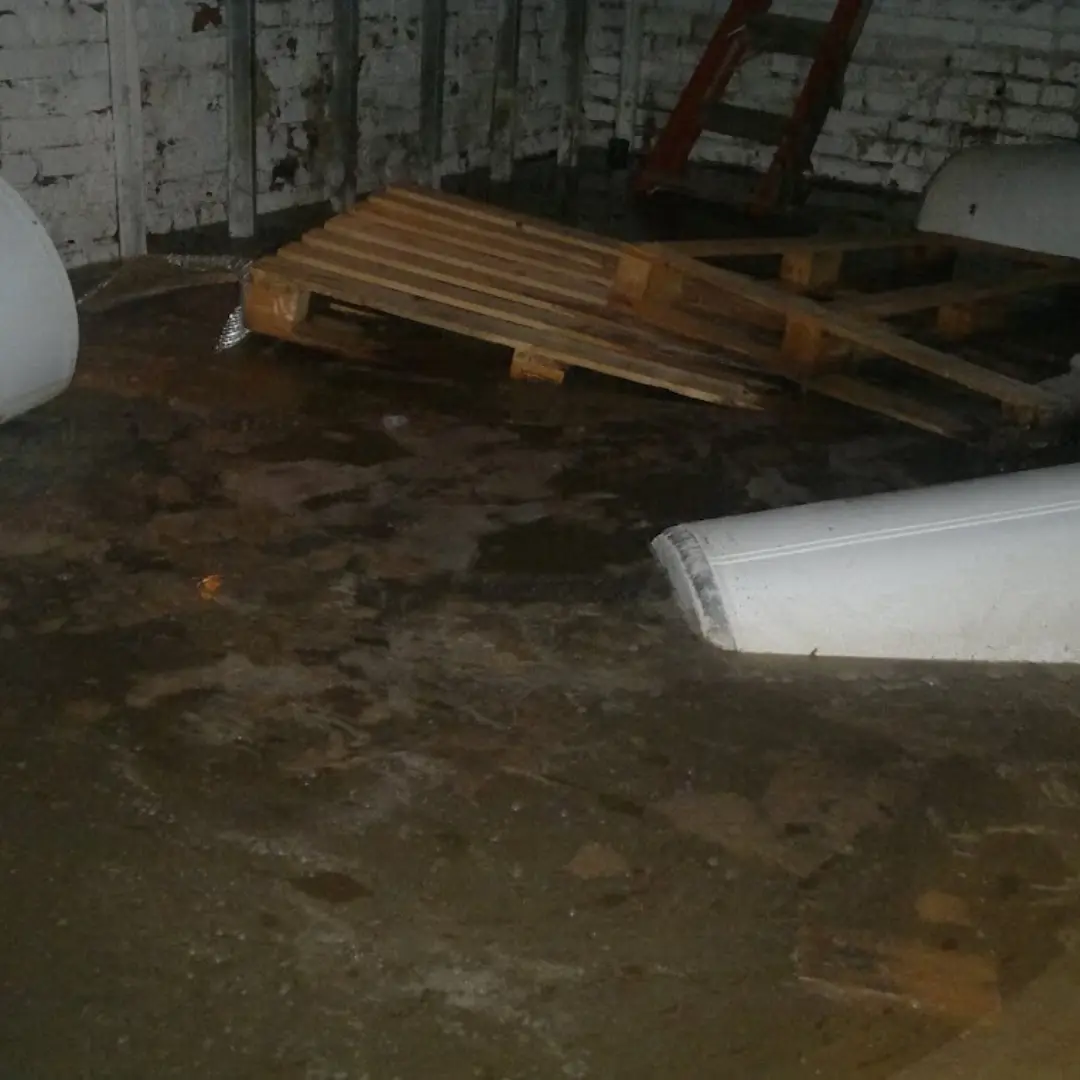
Wet drywall water damage is one of the most common situations we walk into after a Toronto flood or burst pipe. And almost every time, we hear the same thing: "It's already drying out. The walls feel okay. Do we really need to tear anything out?"
Maybe not. But the honest answer is that you can't tell by looking or touching. What happens inside water-damaged drywall in the first 48 hours is exactly why we carry moisture meters and thermal cameras, not just flashlights.
What drywall is actually made of
This matters more than most people realize. Drywall is a gypsum plaster core sandwiched between two layers of paper. That paper is the problem. It's an excellent food source for mould. The gypsum core itself is porous and absorbs water fast, which swells and softens it. Once the paper facing is saturated, it starts to separate from the gypsum. The board loses structural integrity. And none of this is visible from the surface.
Most of the postwar bungalows and semis we work in across Etobicoke, North York, and Scarborough have drywall over fiberglass batt insulation. That insulation holds moisture long after the surface appears dry. In older century homes in Roncesvalles or Leslieville, you may still have plaster over lath, which behaves differently and requires its own assessment.
Hours 0-12: the clock starts
In the first few hours after water contact, the gypsum begins absorbing moisture. If the source is clean water from a burst pipe or failed appliance, the drywall can potentially be saved if you act immediately. IICRC standards allow for accelerated drying of Category 1 water intrusion if drying starts within a few hours and moisture readings support it.
In practice, that means high-velocity air movers pointed at the wall base, commercial dehumidifiers pulling moisture from the air, and a moisture meter reading the wall cavity every few hours to confirm levels are actually dropping. This is not a fan from the hardware store. We're talking about equipment that moves air at a volume in a completely different category from anything residential.
Call during this window with clean water, and there's a real chance the drywall stays. That's the best case.
Hours 12-24: where most homeowners lose the board
After 12 to 24 hours of sustained moisture, the paper facing starts to delaminate. The gypsum core has absorbed enough water that the board begins to crumble and sag. More critically, mould spores are present in any indoor environment, and they germinate in as little as 24 hours when humidity and a food source align. That food source is the paper.
If the water is grey or black, whether from a drain backup, sewer backup, or anything that sat on the floor before coming up the wall, IICRC protocols classify this as Category 2 or Category 3 contamination. In those cases, the drywall in the affected zone almost always has to come out. It's not something you can dry and call safe.
Hours 24-48: the point of no return for most boards
By 48 hours, most drywall that was fully saturated is unsaveable. The gypsum has lost its bond with the paper, the core has softened past the point of holding screws, and visible mould colonies can begin appearing on the paper facing. If your basement flooded and you tried to let things air out for a couple of days, this is likely where you are right now.
The drywall has to come out. At this stage that's not a judgment call, it's physics.
What makes the job more expensive is what we find behind it. We cut out the wet drywall and often find fiberglass batt insulation that's been sitting wet for 48 hours. That insulation has to go too. We're also reading the wood stud framing to confirm it hasn't taken on enough moisture to support mould growth. Dimensional lumber can handle short-term moisture, but after 48 hours we're treating every surface in the cavity.
Beyond 48 hours: what we find in GTA homes that waited
We get calls from homeowners in Mississauga, Vaughan, Markham, Richmond Hill, and Oakville who flooded two or three weeks ago, thought things looked fine, and are now noticing a musty smell. We arrive, run a thermal camera across the walls, and find moisture pockets behind drywall that looks completely normal from the outside.
By this point, mould remediation is no longer a conversation about drying. It's a full project: containment barriers, HEPA filtration, removal of all affected materials, antimicrobial treatment of the substrate, and clearance testing before we close the walls back up.
We've seen what would have been a $3,500 drying job grow into a $14,000 to $20,000 mould remediation because a homeowner waited two weeks to see if things settled. The mould doesn't know you're hoping for the best.
Why the wall surface tells you almost nothing
This is the hardest thing for homeowners to accept, and genuinely understandable. The wall looks dry. Maybe a bit discoloured near the baseboard, but mostly fine. That's because drywall has a painted surface that's somewhat moisture-resistant. The moisture is sitting behind that surface, inside the gypsum, against the vapour barrier, and in the insulation cavity. A properly calibrated pin-type or non-invasive moisture meter reads through that surface. So does a FLIR thermal camera, which shows us the temperature differential caused by moisture retention.
We use thermal imaging on every water damage job we take. It tells us where the water actually went, not where it looks like it went. On a recent job in North York, the homeowner was certain damage was limited to one wall. Thermal showed moisture in three adjacent walls and the ceiling. All from one pipe.
What flood restoration actually costs, and what waiting costs
A water damage restoration job in Toronto for a typical basement with a burst pipe or sump pump failure, caught within 12 to 24 hours, generally runs $2,500 to $6,000 depending on the area affected. That covers extraction, drying equipment, and daily moisture monitoring until readings confirm drywall and framing are back to safe levels.
The same basement going 48 to 72 hours before treatment usually adds drywall removal and replacement, insulation removal, and antimicrobial treatment. The job jumps to $8,000 to $16,000.
If mould has already colonized and remediation is required before reconstruction, you're looking at $12,000 to $25,000 or more depending on extent.
Most of that added cost is preventable. That's what the 48-hour window actually means in dollars.
What to do right now if your walls got wet
If you've had water against your drywall in the last 24 to 48 hours, here's what matters:
- Stop the source first. There's no point drying walls that are still getting wet. Shut the main water supply for a pipe issue. Stop all water use in the house for a drain backup.
- Get air moving. Open windows if outdoor conditions are drier than inside. This helps but doesn't fix a wet wall cavity on its own.
- Don't punch holes in drywall to "let it breathe" unless a restoration professional tells you to. You may disturb insulation and create other problems.
- Call for a moisture assessment. A good flood restoration company will do initial moisture readings and give you an honest picture of what needs to come out versus what can be dried in place.
- Document everything before anything is moved or removed. Video every corner of the affected area. Your insurance adjuster needs that documentation, and missing it can complicate your claim.
Most standard Ontario home insurance policies cover sudden water damage from pipes. Sewer backup is usually a separate add-on rider. Call your broker and get the claim started early. We bill insurers directly and can deal with the adjuster on your behalf so you're not managing the back-and-forth yourself.
One honest note
We don't push homeowners to replace more than we have to. Unnecessary demolition costs everyone money, including us. When moisture readings say drywall can be dried in place, we dry it in place. But when the numbers say it can't, we tell you that clearly, with the readings to back it up, and we walk you through exactly why.
If you've had water damage in the last 24 to 48 hours, or you're smelling something musty from a flood you thought you handled, call us at 647-563-9966. We're IICRC certified, we answer every hour of the day, and we can get a crew to you the same day anywhere in the GTA.
The Preferred Group
IICRC Certified restoration team. Toronto-based, working across the GTA since 2006. 6,000+ projects under our belt.